
AnalystX for funds
The Operating System for
Built for one reason: somewhere in your pipeline is the fund-returner, and nobody at your firm has looked at it since March
Deal flow, LPs, co-investors, and your firm’s memory in one place.
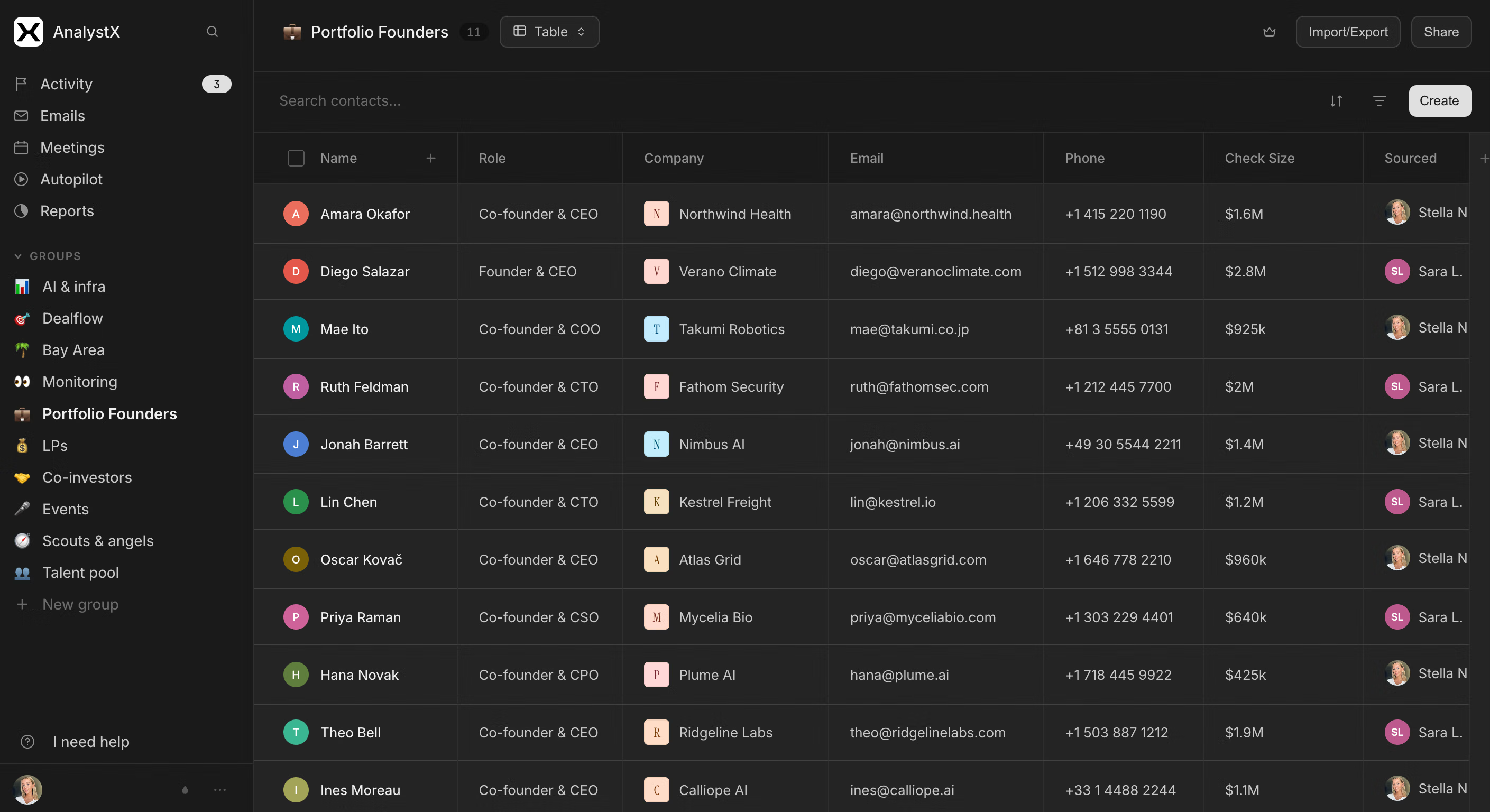
- Deal flow, LPs, co-investorsModelled on day one.
- Your team’s emailRead back through the archive.
- Your own agentPointed at your own data.
Does this sound familiar?
Hey! There’s a good chance I know why you’re here.
Your job is to find the fund-returners. Most days, it’s 20 open tabs.
You’re the one who opens HubSpot, then Airtable, then Slack, to answer one question. You’re the one who remembers that a partner met that founder in 2023, because nothing else does. And somewhere in all that plumbing is the dealflow case you should have called back in March.
A fund’s only real asset is the intelligence it has accumulated: two thousand companies seen, six thousand people met, ten thousand small judgments about which markets are fake and which founders were early rather than wrong. That’s what your LPs are actually paying for. And it lives in three inboxes, one partner’s head, and a spreadsheet called Dealflow Aug ’26.
Not because anyone’s careless. Because there has never been anywhere to put it. Every CRM you’ve been offered was built to move generic leads through a funnel, so it all goes back in the inbox and every month a little more of it evaporates. Salesforce needed a consultant. Notion turned out to be a very good Lego castle. Attio loads forever. Nothing fits, so we built the opposite.
AnalystX opens already knowing what a fund is, then bends to whatever yours actually tracks. It reads your team’s email back through the archive, so you type a founder’s name and see who’s already met her. And it notices when something’s gone quiet instead of waiting for you to wonder.
You’ll still miss deals. Everyone does. But not because nobody looked.
Thanks for taking a look.
Nothing to configure
Set up for your firm
from day one.
- Deal flowwhere it came from, who owns it, what happened to it
- Companiesstage, sector, thesis fit, and every touch the firm has had
- Founders and peoplewho met them, when, and whether it went well
- Portfoliothe work after the wire: intros, hiring, the next round
- LPscommitments, reporting, and what you promised on the last call
- Co-investorswho leads what, and who owes you a look
- Eventsthe dinner, the demo day, and everyone you actually met
Understand first. Connect second.
We start with the way your firm actually works.
Before we connect anything, our dedicated technical support team learns what your team uses every day: the systems, handoffs, approvals, and routines that keep deal flow and portfolio work moving.
Then AnalystX’s unique workflow engine lets anyone on your team connect any API and automate the handoffs around it, without vibecoding a critical system or taking on an endless DIY integration project. Our dedicated technical support team helps you put the workflow into practice and keep it moving.
Your existing stack
Bring the tools your firm already uses.
Research, relationships, portfolio reporting, fund operations, and data rooms each do a different job. AnalystX connects the context between them.
It already knows
what a fund is.
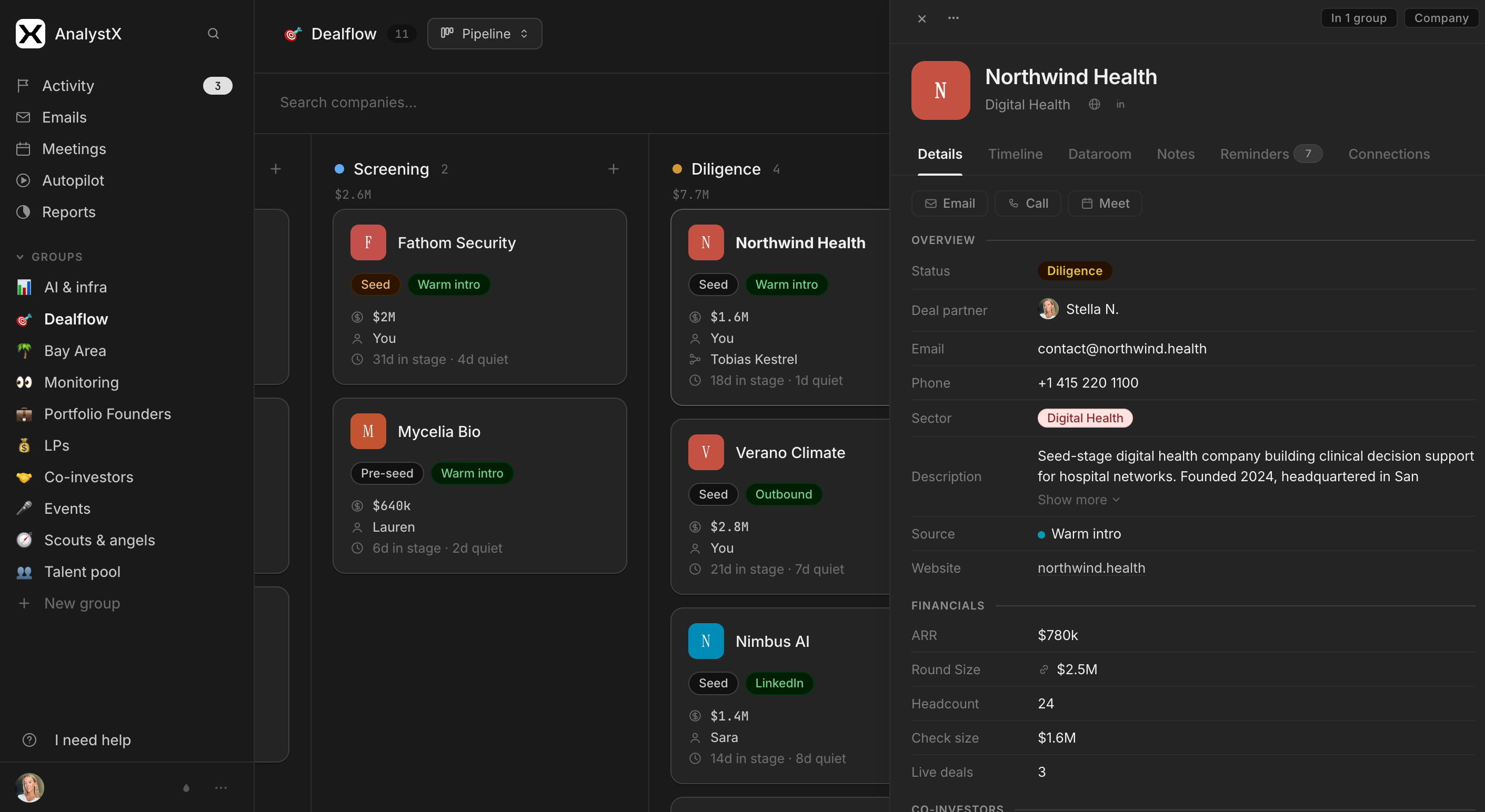
Deal flow, LPs, co-investors, portfolio, datarooms, the accelerators you source from. All there on day one, named the way you'd name them, related the way they actually relate.
From there you adjust it. Add the fields your fund tracks, hide the ones it doesn't. No consultant, no empty database to design first, no weekend spent building a CRM before anyone can use it.
Your seed round is 60% likely to close in Q3.
That is what a sales CRM actually told you. Every generic CRM asks a fund to describe its work in these words.
Yes, you can rename all of it. Three days of admin later it still believes a round is a sale, and the new analyst still has to be told what “Custom object 4” means. Why bother?
Northwind Labs
Opportunity- Lead status
- MQL
- Opportunity stage
- Discovery
- Close date
- 30 Sep
- Win probability
- 60%
- Deal amount
- 2,000,000
- Forecast category
- Commit
- Territory owner
- Unassigned
- Custom object 4
- Co-investors
Related the way
a fund relates them.
You met her in 2023 running a seed-stage company you passed on. In 2025 she angel-invested alongside you. In 2027 she is the CTO of a company you are diligencing. Three records in a sales CRM, one person here.
Notion will let you model all of it, and then you maintain it forever. AnalystX ships with the relationships already drawn.
You describe the job.
Autopilot does it.
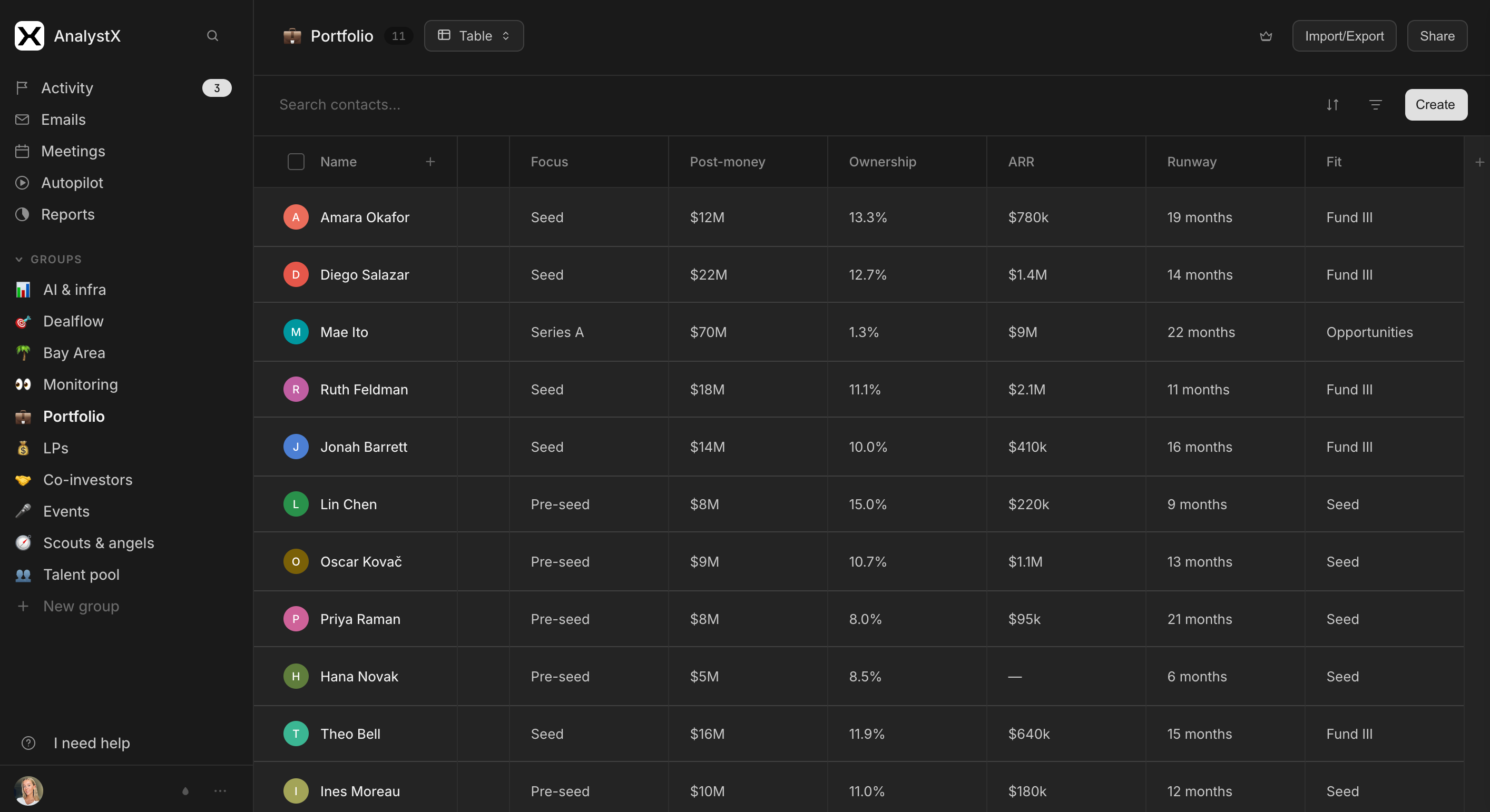
Everyone should have someone to hand the boring work to. Autopilot is yours, and it works while you're in meetings.
Just tell it what you want, in plain words: “remind me when a founder we've met goes quiet for a month.” It shows you exactly what it'll do, you say go, and it quietly handles the rest. It keeps working after you close the tab.
Your LLM, your data,
full speed.
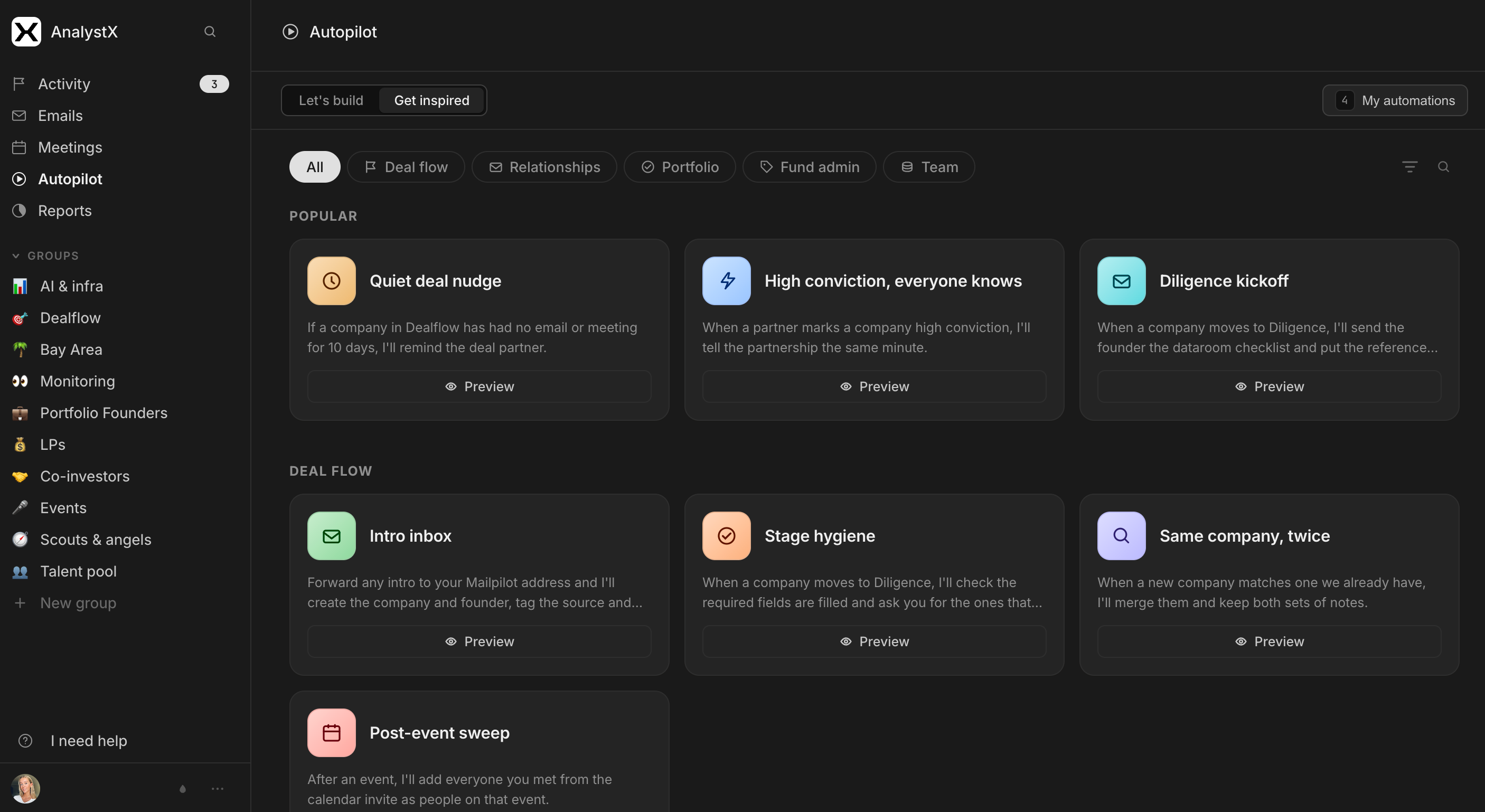
We won't give you an under-performing AI assistant. You already pay for a good one. Point Claude or ChatGPT straight at your fund's intelligence and ask it anything you'd ask an analyst.
Which of our co-investors leads seed rounds in fintech? Draft the LP update section on our Q3 activity. When AI gets all context, it puts your firm’s network to work.
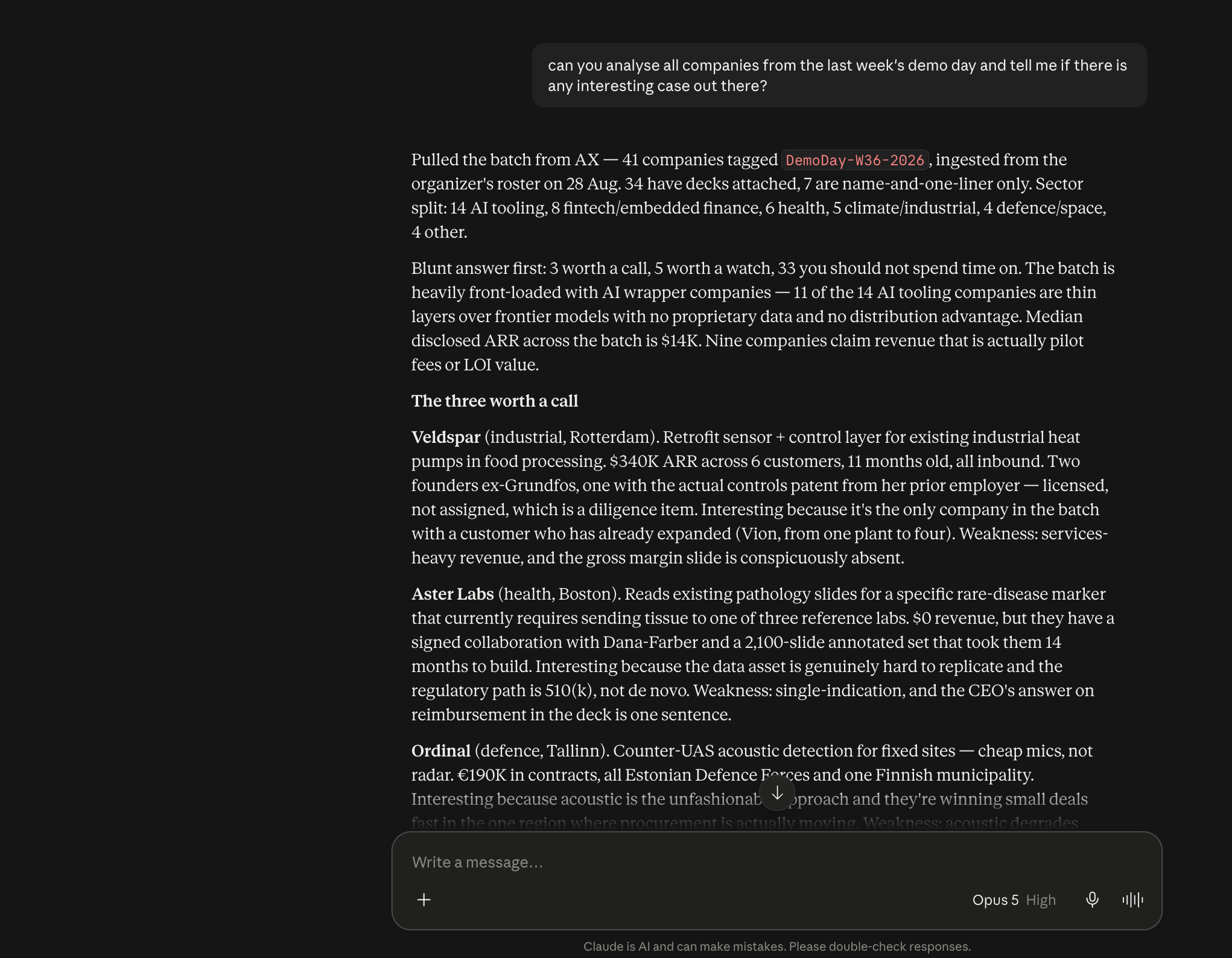
Connect the stack you already use
AnalystX fits
your platforms.
AnalystX becomes the relationship layer across the tools your firm already uses.
Connect Gmail or Outlook and calendar context, give your team’s assistant access through MCP, or use the REST API when your own systems need to read and write fund records. Bring in a spreadsheet, PDF, or pasted notes when the history is somewhere else.
- Email and calendarKeep conversations and meetings attached to the right company, person, LP, or portfolio record.
- Claude, ChatGPT, or any MCP clientAsk questions across AnalystX and the rest of your connected stack from the assistant your team already uses.
- Your own systemsUse the REST API for custom workflows, imports, reporting, and operational handoffs.
Everyone in the firm
will actually use it.
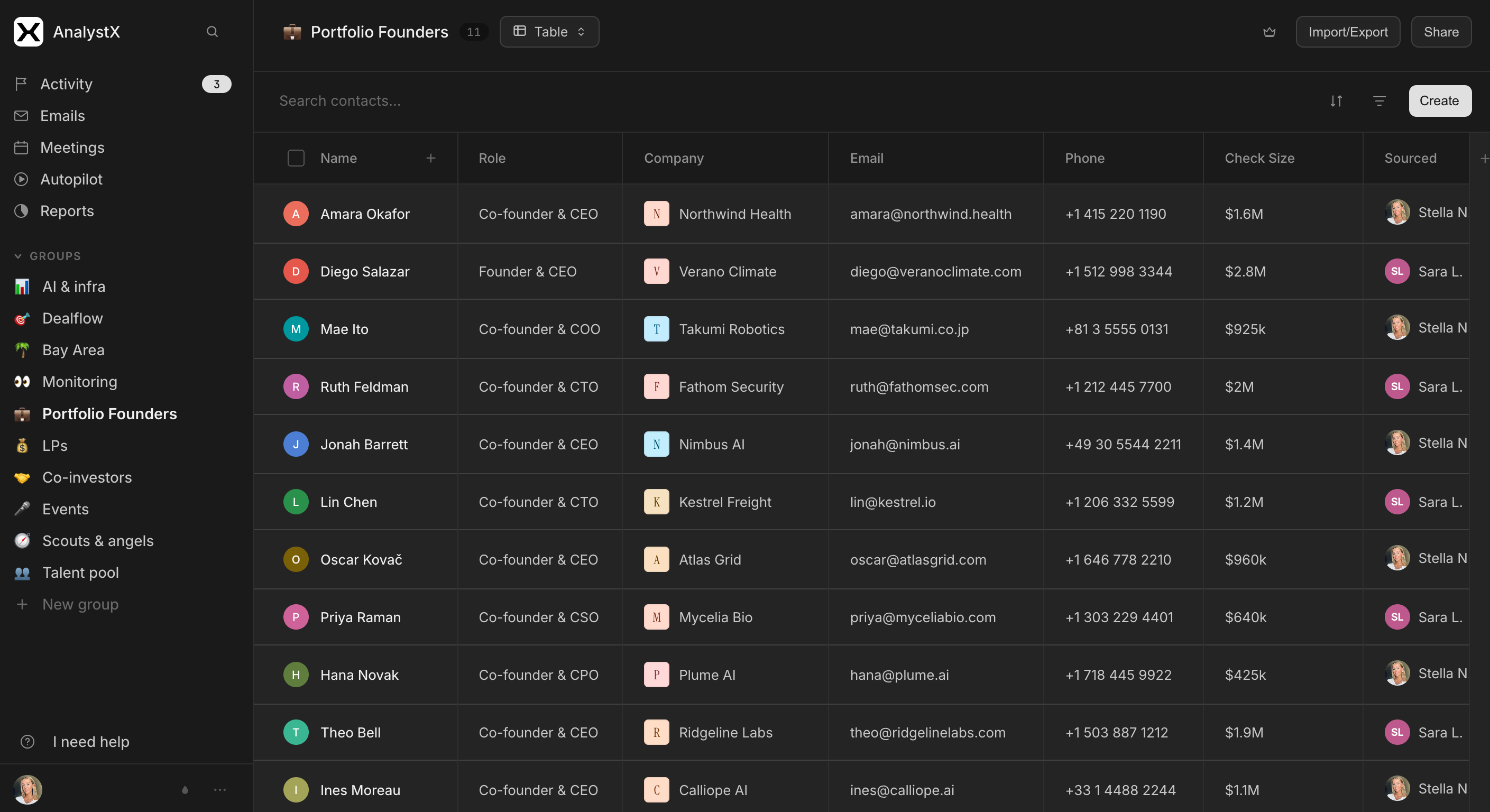
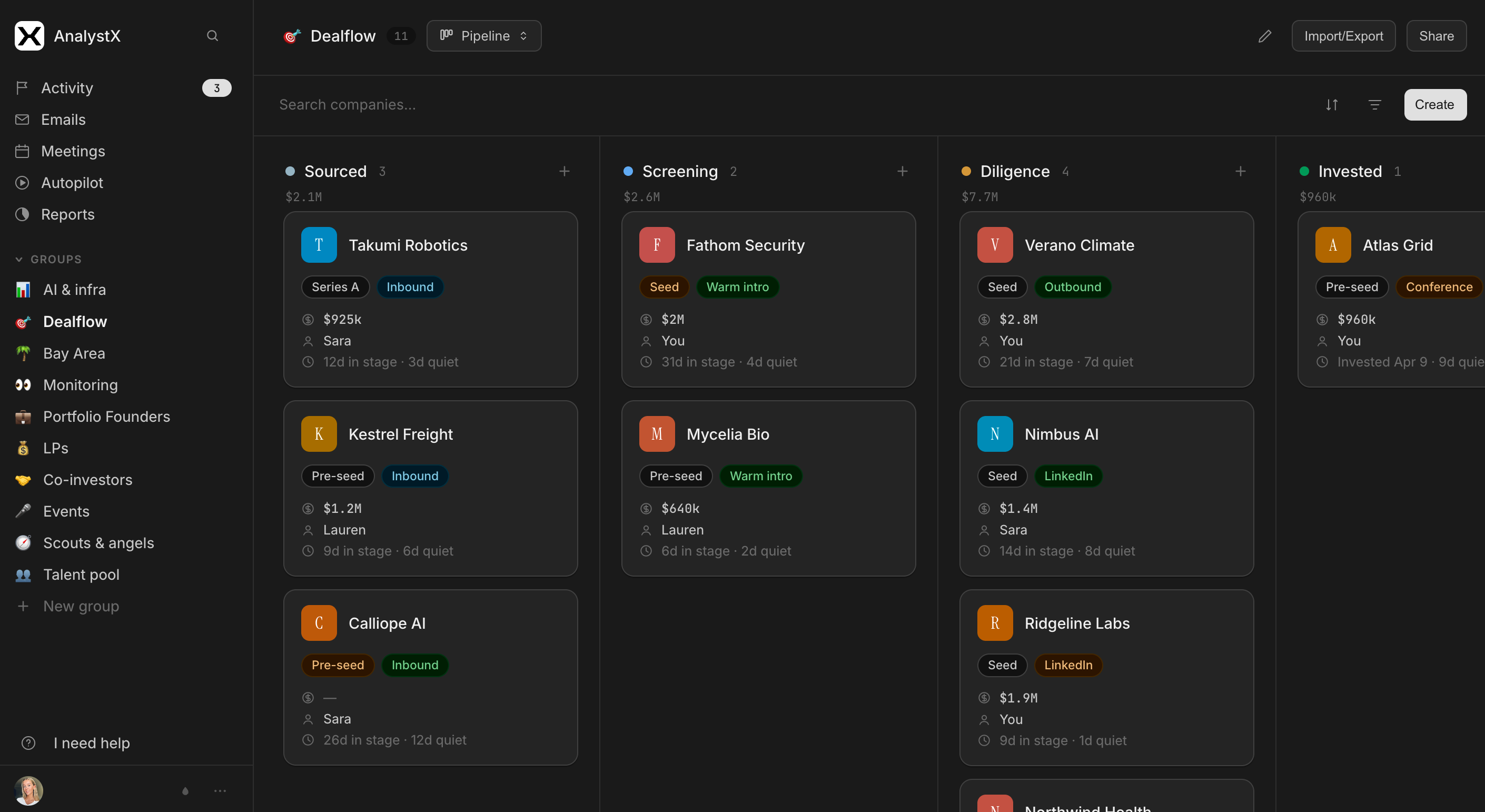
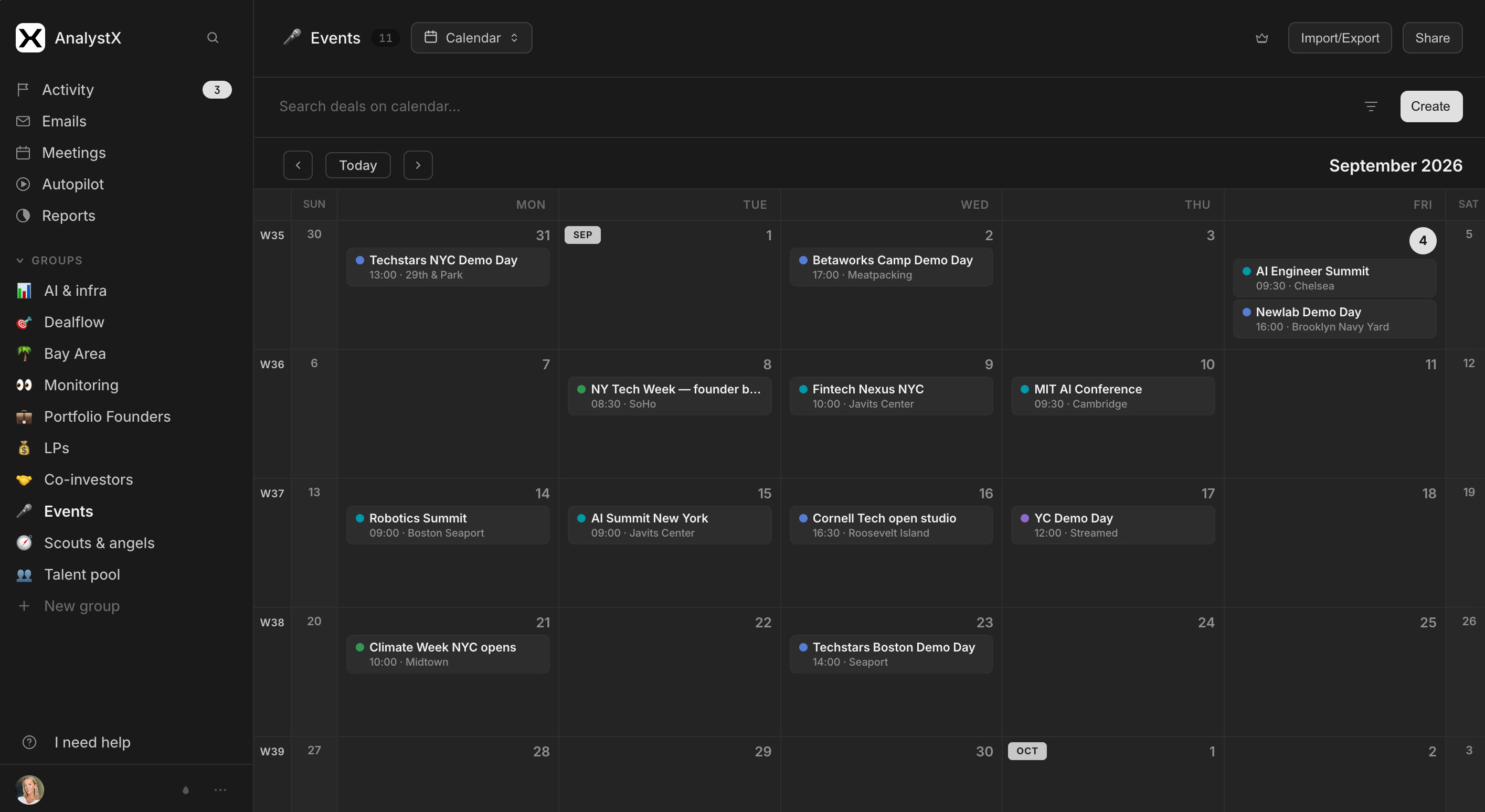
Nothing to learn, nothing to configure. It works like the tools they already live in, so adoption isn't a project you have to manage. See it as a table to scan and edit, a pipeline to drag a round through, or a calendar for what's coming.
Two things a fund asks for
It will do it.
Somebody has to.
This is not a list of things Salesforce cannot do. It will do all of it, and do it well. The question the price page does not answer is who at your firm is going to sit down and make it happen, and what they stop doing while they do.
Can we track LPs and what they have committed?
- Scope it with the implementation partner
- Design the custom object
- Build the lookup back to Account
- Add the fields, then the page layout
- Write the validation rules
- Set the profiles and permission sets
- Build it in a sandbox first
- Deploy it with a change set
- Retrain the team on the new tab
A statement of work, and an admin who now owns it
LPs, commitments and capital calls are there on day one, with what you promised on the last call.
Can we rename a stage before Monday?
- Ask the admin
- Wait for the admin’s queue
- Change the picklist value
- Fix the reports that filtered on the old one
- Fix the dashboards fed by those reports
- Fix the automations that referenced it
Somebody else’s calendar
You rename it yourself, in the interface, and nothing downstream breaks.
None of this is Salesforce working badly. This is Salesforce working exactly as designed, for a customer who has an administrator.
Nobody’s job
to maintain.
Every plan runs the whole product. The plan only decides how many people are on it.
- Deal flow, LPs, co-investors, portfolio and datarooms, on day one, with no object to design first
- Reporting, compliance and portfolio management, with analytics connected to the records the team already uses
- Your email archive read back in time, so a new analyst inherits the firm’s memory rather than an empty tab
- Autopilot, for the follow-through nobody has time to think about
- Agent access over MCP, using the Claude or ChatGPT your firm already pays for
- One price for the firm, partners, analysts, the EA and the scouts included
No statement of work, no sandbox, no administrator, and no partner agency in the room.
Questions about
the model.
Why does the vocabulary matter?
Because a word carries a shape. “Opportunity” assumes one pipeline moving toward one close date, so a sales CRM will happily tell you a seed round is 60% likely to close in Q3. A fund does not work that way, and a month of renaming fields does not change what the software believes underneath.
Can we rename things to match our firm?
Yes. AnalystX starts with fund-native objects and relationships, then lets your team adjust labels and fields to match its process. You do not have to invent the model or build a CRM from scratch.
What if we track something unusual?
AnalystX gives you a fund-native starting point, then connects the platforms and systems that hold the rest of your firm’s context. Use email and calendar connections, MCP, the REST API, or imports when the workflow lives somewhere else.
Is this just renamed Salesforce?
No. Salesforce and HubSpot model one pipeline to one outcome, and everything else is a custom object you maintain. AnalystX relates companies, people, rounds, LPs, co-investors and events the way a fund actually relates them, so the same person can be a founder in 2024 and an angel in 2027 without you building anything.
What makes AnalystX different from sales CRMs and productivity software?
A sales CRM tracks one kind of thing moving through one pipeline toward one outcome. Productivity software tracks nothing until you tell it to. A fund tracks eleven kinds of thing that all relate to each other: companies, the people at them, deals, portfolio, co-investors, LPs, events, the accelerators that surface founders. The same person is a founder, then an angel, then an operator at a company you’re diligencing. The same company throws a deal in 2024 and another in 2027. Sales tools flatten that, Notion asks you to model it yourself, and either way a fund spends a month building before anyone can use it.
Will everyone in the firm actually use it?
The only question that matters. Two things decide it. Speed: people abandon anything that makes them wait, and they don’t complain first, they just stop opening it. And effort: if logging a call means inventing a note title before the system will save it, nobody logs the call. We built around both, so there is nothing to roll out and nobody to chase.
Who keeps it up to date?
Nobody, which is the point. Funds rarely have anyone whose job is the CRM, so any system that has to be fed by hand goes stale within a quarter. Email and meetings log themselves against the right company and person, records fill themselves in, and Autopilot handles the chores. The only thing worth typing is your judgment.
How long does moving off Affinity, Attio or a spreadsheet take?
A weekend, usually an afternoon. Bring your export as it is, notes and all, without cleaning it first. Then connect the team’s email and calendars and the history fills in behind you, so the archive is searchable from day one rather than starting from the day you signed up.
How does this help us find the fund-returner?
It makes the fund’s own history usable. Most misses are not judgment calls, they are companies nobody looked at twice: a founder a partner met in 2023, a company that went quiet before the round, a market three people flagged separately and nobody connected. AnalystX keeps all of that on one record and tells you when something moves, so the decision is a decision rather than an accident of who remembered.
Can we adapt it to how our fund works?
Yes. AnalystX already includes the fund-native model, and you can connect the platforms your team uses through email, calendar, MCP, the REST API, or imports. The point is to make your existing workflow more connected, not ask your team to become a CRM implementation project.
AnalystX for funds, investors & PE
See what AnalystX can do for your firm.
Book a dedicated AnalystX walkthrough for your deal flow, LP relationships, reporting, compliance, portfolio management, and investment workflows.