G2 reviewers praised Breakcold's LinkedIn-focused social CRM, campaigns, interface, and responsive support.
Breakcold is built for outbound.
SoftSync is built for what happens after.
Breakcold and SoftSync solve different parts of the sales journey. Breakcold is focused on creating outbound conversations; SoftSync keeps the customer record, meeting context, next steps, and repeatable follow-up connected after the conversation starts.
Side-by-side
SoftSync vs Breakcold
Breakcold now covers a serious outbound motion: multichannel inbox, five channels, custom pipelines, AI admin, and reports. SoftSync wins the comparison when the job continues after the outbound conversation: meeting, decision, proposal, customer record, and repeatable follow-up.
Feature scope checked against Breakcold sales-team product scope and Breakcold help centre.
| What matters | SoftSync | Breakcold |
|---|---|---|
| Primary job | Run the customer journey from outreach and email through meetings, opportunities, follow-up, and ongoing work. | Help salespeople create and work multichannel outbound conversations across email, LinkedIn, WhatsApp, Telegram, calls, and meetings. |
| CRM model | Use custom records, fields, groups, views, and linked customer history for the process after the first reply. | Custom pipelines, stages, and fields shaped around outbound activity and conversations. |
| Conversation to record | Capture computer calls and meetings with the desktop app, review the summary, and attach it to the right record. | Multichannel inbox, Chrome extension, AI CRM actions, MCP access, and live reports for the outbound side. |
| Best fit | Founders and SMBs that want outreach, meetings, customer history, and repeatable follow-up in one subscription. | Teams whose biggest bottleneck is generating outbound activity and engaging new prospects across channels. |
Why SoftSync wins after
the outbound conversation.
Breakcold is built around multichannel outbound. SoftSync carries the customer forward after the conversation starts: email, meetings, customer history, proposals, and repeatable follow-up in one connected CRM.
- Enrichment becomes part of the customer record. Breakcold includes broad enrichment in its base plan. SoftSync's enrichment workflow completes and maintains the records already in your sales process, so researched context stays attached to outreach, meetings, and follow-up.
- SoftSync carries the conversation into the customer journey. Breakcold brings LinkedIn, Telegram, WhatsApp, Gmail, and Outlook together for outbound conversations. SoftSync keeps email, calendar, meetings, and the customer record connected after a conversation becomes an active opportunity.
- The meeting updates the right record. Breakcold includes meeting capture. SoftSync's desktop app captures computer calls and meetings, then attaches a reviewed summary to the relevant CRM record and its next action.
- Custom records support the whole process. Breakcold does not present the same per-object capacity model. SoftSync Pro holds 250,000 records per table, Business holds 1,000,000, and Enterprise is available for custom requirements, with flexible records for the customer work around each opportunity.
- AI can act on the CRM context. Both products describe connections to external assistants. SoftSync also provides a documented API and MCP surface for teams that want an assistant or internal tool to work with CRM records, meetings, and next actions.
- The product advantage is workflow coverage. Breakcold has a larger public review footprint. SoftSync connects outbound context to customer history, meetings, proposals, and repeatable follow-up in one CRM.
- The plan should cover the work after the reply. At five seats sharing two accounts, Breakcold is $1,668 a year against SoftSync Pro at $1,740 in the example below. SoftSync puts the connected customer record, meeting context, proposals, and follow-up in the same operating surface after outbound creates the reply.
Read the two homepages
next to each other.
Breakcold presents outbound activity as the centre of the workflow. SoftSync presents the connected customer journey as the centre. Both can reduce admin, but at different points: Breakcold while a seller is prospecting, SoftSync as replies become meetings, opportunities, and next actions.
- LinkedIn, across their two pages. 19 mentions
- Invoice. zero mentions
- Renewal. zero mentions
- Automation. zero mentions
Counted from the text of breakcold.com and breakcold.com/pricing on 10 September 2026. The three zeros are also zero in the page source, so those words are not in what their server sends at all. That describes the product focus: Breakcold is built for the outbound stage where a team is finding and engaging prospects. SoftSync is built for the connected customer work that follows. The useful question is which stage is currently costing your team the most time.
Price the outbound motion
your team actually runs.
Breakcold's pricing is clear: one plan, sliders, and published adjustments for seats and connected accounts. $99 covers one seat and two connected accounts, and every extra seat or account is $10 a month. For a five-person team, the useful comparison is the number of people and inboxes involved in outbound, alongside the value of keeping the later customer journey connected.
One person
$1,188 a year
$348 on Pro
Five people, two shared accounts
$1,668 a year
$1,740 a year
Five people, each with LinkedIn and email
$2,628 a year
$1,740 a year
Our arithmetic uses their own published sliders, read 10 September 2026: $99 base, plus $10 a month for each seat past the first and each connected account past the second. The examples show how the cost changes with the size of the outbound team and the number of inboxes. They offer a 14-day trial rather than a free tier. Their base plan includes 3,000 AI CRM actions a month; SoftSync Pro includes 1,000 campaign emails, enrichments, and chats per user/month, while Business includes 10,000.
Keep outbound active, then keep follow-up moving. asleep.
Breakcold focuses on helping a seller work outbound channels efficiently while they are in the process. SoftSync focuses on what should happen around the customer record after the conversation starts: capture the meeting, preserve the context, and turn repeatable follow-up into background work with Autopilot. The decision is where your team needs more leverage.
- Chase unpaid invoices politely until they're paid.
- Tell me when a customer hasn't heard from us in a month.
- Remind me when a deal goes quiet for two weeks.
After the handshake.
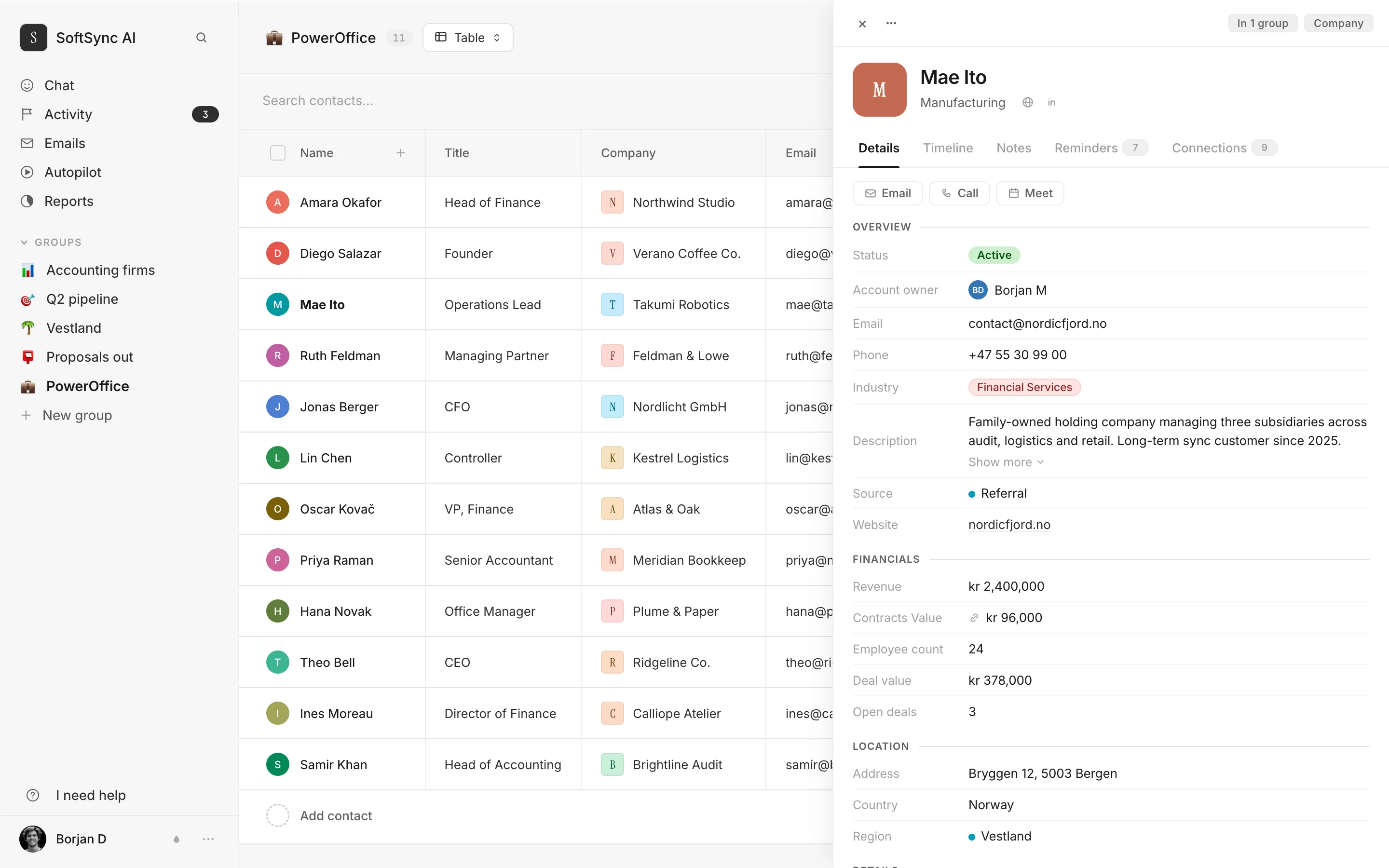
What was agreed, what was delivered, what was invoiced, what hasn't been paid, and who hasn't heard from you since March.
Emails file themselves against the right customer, the calendar syncs, and the follow-ups happen whether or not anyone remembers. These connected sales workflows are part of the published SoftSync plans.
Which part of the sales motion
needs the most support?
Six jobs, and the decisive question is where the team wants the most leverage. Breakcold is built around creating outbound conversations; SoftSync is built around carrying customer work from the first reply through meetings, proposals, and follow-up.
Building pipeline on LinkedIn
Breakcold
Breakcold is purpose-built for LinkedIn-led prospecting and multichannel outbound. SoftSync focuses on the customer record and follow-up after the conversation becomes active.
from usBreakcold is built for multichannel outbound; SoftSync is built for the connected customer journey after the first reply.
Conversations across five channels
Breakcold
LinkedIn, Telegram, WhatsApp, Gmail and Outlook in one inbox, syncing by themselves. Genuinely rare.
from usSoftSync connects email and calendar to the CRM record, while Breakcold concentrates on outbound channels.
Enriching a person or a company
Breakcold
Breakcold offers broad prospect enrichment. SoftSync's enrichment workflow is designed to complete records already in the sales process, so the comparison is prospect discovery versus carrying complete customer context through the rest of the journey.
from usSoftSync enriches records already in the CRM; Breakcold is built around finding and engaging new prospects.
What was agreed, invoiced, and never paid
SoftSyncthat's us
SoftSync keeps customer records, commercial context, and follow-up together for the work after a prospect becomes an active customer or opportunity.
Following up when nobody remembers to
SoftSyncthat's us
Autopilot turns repeatable follow-up into background work, so the team can keep the next action attached to the right record.
Starting with a small sales team
SoftSyncthat's us
SoftSync's published plans are designed around a working CRM and connected customer context. Breakcold's single-plan pricing is useful when outbound activity is the team's main need.
How this list is made
The list gives Breakcold the jobs its product is built around and SoftSync the jobs our connected CRM is built around. A useful comparison should make that boundary clear rather than award every row to one product.
Every competitor figure on this page is taken from its own published material with the date we read it, including the pricing examples. If one is wrong, tell hello@softsync.ai and we'll fix it and re-date it.
Some teams may use both: Breakcold for multichannel prospecting and SoftSync for the customer record, meeting context, and follow-up after the conversation becomes active. The useful combination depends on whether outbound reach or post-reply coordination is the bigger priority.
Buyer evidence about Breakcold
The best and worst real feedback about Breakcold
These are the clearest positive and critical signals from real Breakcold reviews, and the reason to look at the whole sales workflow.
A G2 reviewer liked the distinctive LinkedIn prospecting but described a learning curve and said the integrations were mostly LinkedIn-focused.
See the difference in practice
Bring one real sales workflow and see whether customer context, meetings, and follow-up stay connected.
Questions.
How should we compare the price?
At five seats sharing two accounts, the example above puts Breakcold at $72 less per year. That difference buys an outbound-focused workflow; SoftSync carries the customer record, meeting context, flexible CRM structure, and follow-up after the first reply in the same workspace.
You don't do LinkedIn at all?
Breakcold is designed around LinkedIn and other outbound channels. SoftSync is designed around the customer record, meeting context, and follow-up after the outbound conversation, so the seller does not lose the process at the first reply.
Could we use both?
It is possible, but it creates a handoff between outbound activity and the customer record. SoftSync keeps the active customer process together after the first reply: meeting context, proposals, history, and repeatable follow-up in one workspace.
Can we move from Breakcold to SoftSync?
Yes. People, companies, pipelines, notes and conversation history come across from an export. Your connected-channel setup doesn't, because it's tied to their accounts.
Does Breakcold replace the CRM?
Breakcold is built around multichannel outbound. SoftSync takes the process from the first reply through the customer record, meeting, proposal, and repeatable follow-up, which is the work a seller still needs after a prospecting conversation starts.
What does Breakcold cost, exactly?
From their pricing page, read 10 September 2026: one plan at $99 a month, including 1 seat, 2 connected accounts and 3,000 AI CRM actions, plus unlimited enrichment. Extra seats and extra connected accounts are $10 a month each. A 14-day trial, and no free plan.
Choose the system
for the work you need next.
SoftSync gives meetings, proposals, customer history, and follow-up one connected workspace after the first reply. Bring the outbound motion and see how the rest of the customer journey stays attached to the record.