
G2 reviewers described Airtable as the sweet spot between a database and an app builder, with flexible views, interfaces, and automations.
Airtable gives you the parts.
SoftSync gives you a CRM that is ready to use.
Airtable is a powerful flexible building system. SoftSync starts with a working sales workspace, then lets you shape records, fields, views, and workflows around your business without taking on the job of maintaining the whole CRM yourself.
Side-by-side
SoftSync vs Airtable
Airtable gives a team excellent building blocks: relational tables, interfaces, automations, and AI. SoftSync gives a sales team a ready CRM workspace, then keeps the customer context moving without asking someone to build and maintain every piece.
Feature scope checked against Airtable product basics and Airtable pricing.
| What matters | SoftSync | Airtable |
|---|---|---|
| Starting point | Start with a working sales structure for customers, companies, opportunities, conversations, and follow-up. | Start with flexible tables, fields, relationships, views, interfaces, and AI, then assemble the workflow yourself. |
| CRM context | Email and reviewed meeting summaries sit with the related record instead of living in a separate inbox or note. | Excellent structured data and interfaces; conversation capture and CRM behaviour depend on the setup around the base. |
| Automation and AI | Use AI Assistant and Autopilot for customer work, with API and MCP support for custom extensions. | Automations, Omni AI, and an extensible platform for teams comfortable building their own operating layer. |
| Best fit | A sales team that wants flexible CRM structure without becoming the long-term maintainer of its own CRM build. | Teams that need a general-purpose relational building system for many kinds of work. |
Start with flexible structure.
Then choose the sales workflow.
Airtable gives teams tables, fields, links, views, and automations to shape into a system of their own. SoftSync starts with the customer records, views, and follow-up a sales team needs, then leaves room to adapt the structure as the business becomes clearer.
What Airtable ships you5
- Tables and fieldsEvery shape you could need, and no opinion about which one you do.
- Links between recordsThe relationships, once you have decided what they are.
- Views and interfacesAs many as you are willing to design and maintain.
- AutomationsPowerful, and yours to wire up.
- An enormous template libraryA broad library of starting points for different teams.
What's still yours to do5
- Deciding where a new field goesAnd how the team keeps those views aligned as the process changes.
- Handing the workspace to a new teammateA system the next teammate needs to understand quickly.
- Noticing an automation stopped firingA shared ownership decision, so customer-facing work stays current.
- Maintaining the system as the team growsA data model that needs clear ownership and documentation.
- The operating timeThe time required to design, review, and maintain the system.
Airtable's build-first model is useful when a team wants to design a general-purpose system. SoftSync starts assembled for customer work: import a spreadsheet and the team has contacts, companies, deals, tasks, and a timeline ready to use, with room to adapt records, fields, views, and workflows later.
Keep every customer conversation
with the customer record.
A CRM becomes more useful when email, meetings, and next steps stay with the customer record. Airtable's documented strengths are its data-building tools; SoftSync connects Gmail and Outlook so the history around a sales conversation can remain available beside the record.
- Email sync. zero mentions
- Two-way email. zero mentions
- Calendar sync. zero mentions
- Email tracking. zero mentions
The Airtable comparison reflects the visible product and pricing information read on 10 September 2026. Airtable can send email through automations, while SoftSync connects Gmail and Outlook on its published plans so teams can keep email and calendar context alongside the CRM record. Test the exact messages, meetings, and matching rules your team relies on before choosing.
The history is there
when the phone rings.
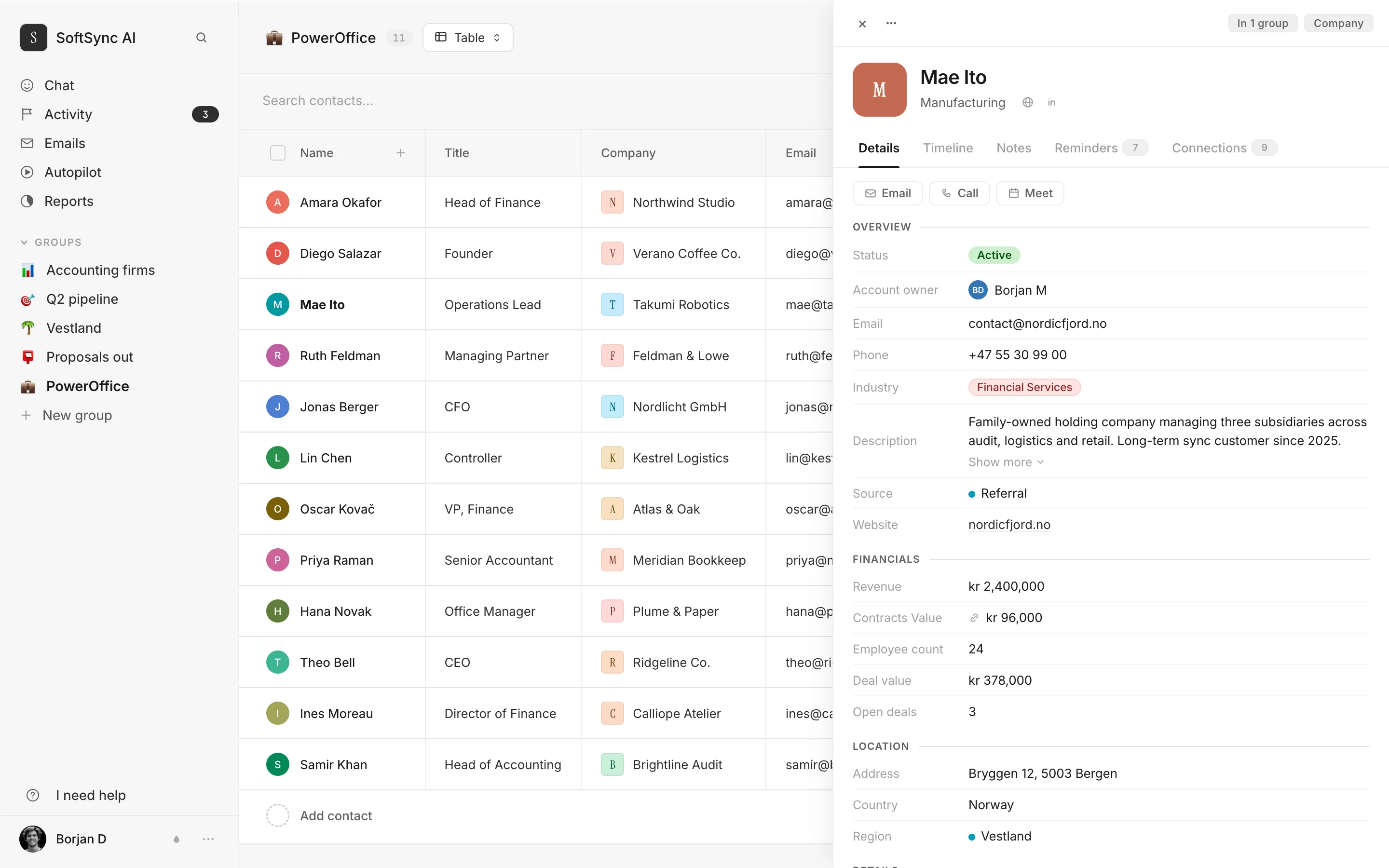
Every email, meeting, note and invoice against the customer, in order, filed by itself. Nobody pastes anything in.
This is the thing a CRM is for, and it's the reason this page exists: customer context stays with the record instead of being rebuilt from memory.
Capacity and history matter
when the sales workspace grows.
Airtable publishes capacity and revision-history details at the base and plan level. That is useful to compare with the sales history and record volume your team expects to keep as outreach, campaigns, and customer conversations accumulate.
Free, $0
1,000
2 weeks
Team, $20 a seat
50,000
1 year
Business, $45 a seat
125,000
a plan feature
From airtable.com/pricing and their plans documentation, read 10 September 2026. Annual prices; Team is $24 and Business $54 monthly. Enterprise Scale is contact-sales and its ceiling isn't published, so it isn't in the table. Airtable says bases remain usable when a limit is reached, while adding more records or attachments requires a plan change. SoftSync also has plan capacity, with 250,000 records per table on Pro and 1,000,000 on Business, plus a custom Enterprise option. Compare the capacity model with the size and structure of the customer history you expect to keep.
Two ways to connect AI
to customer data.
Airtable offers an MCP server for Claude and ChatGPT and AI features inside its apps. SoftSync connects the assistant your team already uses to CRM records and the surrounding sales context. The practical question is the same in both products: does the assistant have access to the records, conversations, and next actions your team needs?
SoftSync documents the records, email, notes, and views available to a connected assistant so a team can review the actions before using them in customer work.
Why SoftSync wins when
sales work is the system.
Airtable is a flexible builder for many kinds of work. SoftSync gives sales teams a ready operating system with flexible records already connected to outreach, email, meetings, AI, and follow-up.
- SoftSync is the ready system for customer work. Airtable can build content calendars, inventory, product roadmaps, campaign planning, and applicant tracking. SoftSync gives sales teams a ready connected CRM and sales process instead of making them assemble the foundation first.
- Flexible structure is already connected to sales work. Airtable is designed for one flexible system across many kinds of work. SoftSync is designed for flexible structure specifically for customer and sales work, with email, meetings, and next actions already connected.
- The sales team can shape the workspace without owning the foundation. Airtable gives a technical or operations-minded teammate a broad canvas. SoftSync gives the sales team a ready customer workflow that can still be shaped without making one person responsible for the whole system.
- Access is designed around people doing the work. Airtable's collaborator model includes free read-only access. SoftSync's Pro, Business, and Enterprise plans are designed around the team members who need to work on customer records, meetings, and follow-up.
- The value is in the work that is ready on day one. Airtable Team is $20 a seat against SoftSync Pro at $29 on annual billing. The comparison is a general-purpose system your team will design versus a connected CRM workflow with email, meetings, AI, and ongoing follow-up ready to use.
Buyer evidence about Airtable
The best and worst real feedback about Airtable
These are the clearest positive and critical signals from real Airtable reviews, and the reason to look at the whole sales workflow.
A Trustpilot reviewer said they were rebilled twice while account permissions prevented cancellation and human support was hard to reach.
See the difference in practice
Bring one real sales workflow and see whether customer context, meetings, and follow-up stay connected.
Questions.
We've already built our CRM in Airtable. Was that a mistake?
No, but the build becomes a liability when the sales process starts depending on it. SoftSync gives the team flexible records plus connected email, meetings, AI, and follow-up without asking one person to maintain every CRM surface.
Can't I connect email with Zapier or an automation?
You can connect tools, but the setup and maintenance become another system to own. SoftSync connects Gmail and Outlook to the relevant customer record so the team can spend more time on the conversation and less time filing it.
You cap records too. What's the difference?
SoftSync Pro holds 250,000 records per table and Business holds 1,000,000, against Airtable's 1,000 per base on the entry plan. Enterprise is available for custom capacity, while custom record types keep customers, deals, invoices, jobs, and other sales objects organised.
Can we move from Airtable to SoftSync?
Yes, and it's usually easy, because your data is already tabular. Export each table to CSV and import it. What doesn't come across is your interfaces, automations and view configuration, which is the part you built.
Their AI is good. Doesn't that beat your AI argument?
Airtable's MCP server is available on every plan according to its published information. SoftSync connects an assistant to CRM records plus the email and meeting context attached to them, so AI record work starts with the sales history already in the workspace.
What does Airtable cost, exactly?
From their pricing page and plans documentation, read 10 September 2026: Free $0 with 1,000 records per base. Team $20 per seat per month annually and $24 monthly, 50,000 records per base. Business $45 and $54, 125,000 records per base. Enterprise Scale is custom and its ceiling isn't published.
Start with the CRM
work already connected.
Airtable is a general-purpose system your team can build and maintain. SoftSync starts with flexible records plus connected email, meeting capture, AI, and follow-up, with support and custom capacity available as you grow.